


Navigating the AACI Applied Experience Exam: a field-tested approach
Canadian Property Valuation Magazine
Search the Library Online


The AACI Applied Experience (AE) Exam is one of the most pivotal milestones on the path to earning the P. App., AACI designation. Having failed it on the first attempt and recently completed it with a high score, I am delighted to share insights that may help other Candidates navigate this demanding but rewarding process.
Understanding the Exam format
The AE Exam is an experiential assessment designed to evaluate a Candidate’s practical application of the First Principles of Value (FPV) and overall professional competence. The exam comprises two main components: a case study and three questions based on applied work experience. Achieving success requires more than technical expertise and practical knowledge; it also demands a thorough understanding of how responses are assessed and presented in alignment with the established grading criteria.
The case study question accounts for 40% of the total marks, while the three work-experience questions together make up the remaining 60%. In the case study section, the exam presents four options, of which Candidates are required to select one to answer in detail. For the work experience component, seven questions are provided, of which three must be selected to showcase Candidate’s breadth of experience and problem-solving skills.
AE Exam expectations
Although the AE Exam measures experiential knowledge, there are many accounts of seasoned appraisers failing on their first attempt. This reminds me of my father, who, despite having over 25 years of experience driving complex manual vehicles in our home country, failed his first road test after arriving in Canada.
The lesson is clear: experience alone may not be enough to succeed in this Exam. Strategic preparation and deliberate practice are essential.
Approaching the AE Exam as one would prepare for a driver’s license road test – by studying the rules, understanding expectations, and rehearsing under realistic conditions – can significantly improve the chances of success.
Fine tune the technical setup – familiarize with the ‘road test vehicle’
Just as a road test candidate may prepare and practice using a basic
no-tech sedan similar to the road test vehicle, it is essential to familiarize yourself with the University of British Columbia (UBC) Canvas Exam Platform and optimize the technical setup before exam day.
- Canvas Exam Platform: UBC provides access to a Sample Format of the Applied Experience Exam on Canvas, which can be accessed by an Exam Candidate repeatedly to gain familiarity with the interface of the actual Exam.
- Internet Connection: Prepare to minimize bandwidth usage from other devices on your network to ensure a stable, uninterrupted connection during the Exam. Keep in mind that live camera streaming during the Exam can impact the overall connection stability.
- Screen Setup: Since the case study response can range from 1,000 to 2,000 words, a small laptop screen may slow a Candidate’s progress with excessive scrolling. A large monitor –
ideally rotated vertically – offers a more efficient and familiar letter-sized workspace, making it easier to navigate and edit your work.
Understand the grading rubric – give the examiner what they expect to see
In a road test, the examiner expects visible mirror checks and shoulder checks for every lane change or turn. As a result, even if the road is 100% clear, a full 180-degree head-turn shoulder check is still expected for a lane change to demonstrate competence.
The same principle applies to the AE Exam: present the answers in a clear and structured format that graders are trained to look for.
- Case Study: Structure the response around the First Principles of Value (FPV), systematically addressing every single element within the FPV. Keep in mind that Highest and Best Use, Research, and Economic Approaches to Value together account for half of the marks in the Case Study, so these require particular emphasis and thorough analysis. The response to the Case Study should be written from the standpoint that you have just been given this assignment and not that you have already completed it.
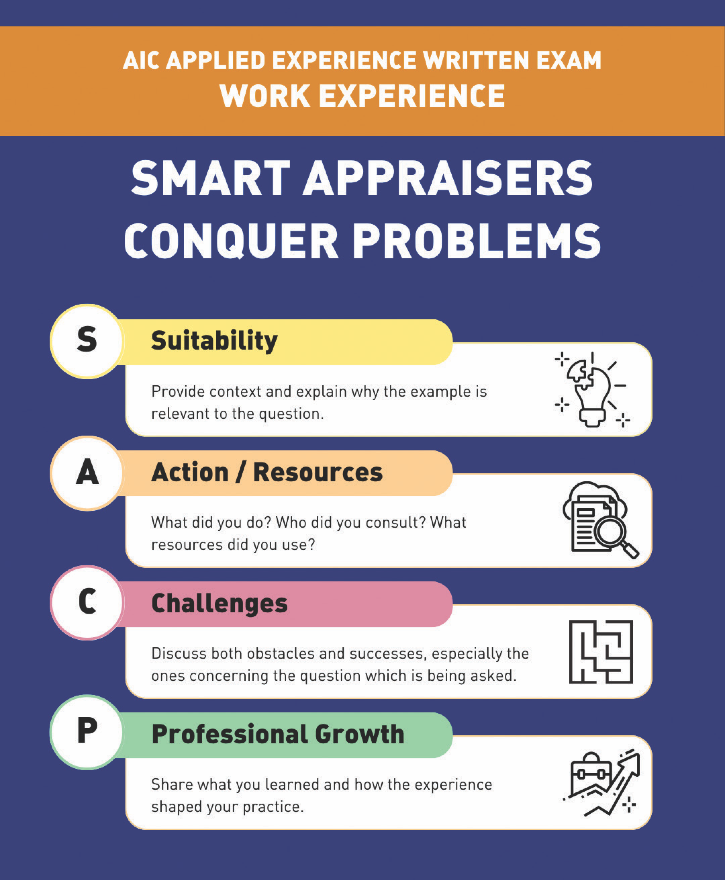
- Work Experience Questions: Present answers in a clear, first-person, past-tense narrative that guides the reader through the context, rising action, challenges, and outcome. Consistently using past tense is critical, as it reinforces to the grader that these are real-world examples drawn from your professional experience. For clarity, I recommend applying the SACP framework (Smart Appraiser Conquers Problem), which I used successfully in the Exam. An infographic accompanying this article provides further detail on how to apply this method effectively.
By aligning answers with the grading expectations, examiners can more readily recognize and credit professional judgment and applied knowledge exhibited on the Exam.
Engage the simulation – practice on the real test route
Road tests become easier with repeated practice along the actual test route. If the route includes parallel parking on a steep slope, rehearsing that scenario repeatedly builds a driver’s confidence
and consistency.
The same principle applies when preparing for the AE Exam. There is no official practice exam published by the AIC. To bridge that gap, I created my own simulation by first selecting several challenging appraisals I had completed in the past. I then role-played the scenario, imagining I was assigned with the same appraisal again, but needed to coach a junior appraiser through the process. At a high level, using a first-person, future-tense format, I outlined how the assignment would be addressed by me step-by-step using the First Principles of Value.
To rehearse effectively, I opened the UBC Canvas Pre-Exam System Test Module, selected ‘Take the Quiz,’ and drafted answers under real-time conditions, while strictly adhering to my time management plan. For example, I allocated 90 minutes to the case study: 30 minutes dedicated to the First Principles of Value sections leading up to the Highest and Best Use analysis, and another 60 minutes focused on Highest and Best Use, Research, and Economic analysis. I approached each practice session with these time constraints to accurately mirror the demands of the actual exam.
The Canvas system test module automatically closes when the time limit expires, erasing all entered responses. To preserve my work, I copied my answers into a separate document before time ran out. Unlike the actual Exam, which disables copy-and-paste functions, the practice module permits it. This allows subsequent review feedback with study partners, mentors, or large language models, helping to identify gaps and refine future answers.
Infographic
Conclusion Success on the AACI Applied Experience Exam rests on practical knowledge, focused preparation, and clear communication. Much like a road test, experience alone may not be enough. By understanding graders’ expectations, rehearsing under realistic conditions, and presenting well-reasoned answers, Candidates can confidently showcase their competence and readiness to earn the AACI designation.